Solar Hybrid + LiFePO4: Designing a Resilient Home Power System for India
The Problem
India’s power grid has improved dramatically, but outages remain a fact of life — especially in Gujarat’s summer months when demand peaks and temperatures hit 45°C. The traditional solution is a UPS inverter with lead-acid tubular batteries: cheap, proven, and available at every electrical shop.
But what if you already have 5kW of rooftop solar panels connected to a grid-tie inverter for net metering? During normal operation, excess solar exports to the grid and you earn credits. During an outage, however, the grid-tie inverter shuts down (anti-islanding protection) — and your solar panels sit idle while you sweat in the dark.
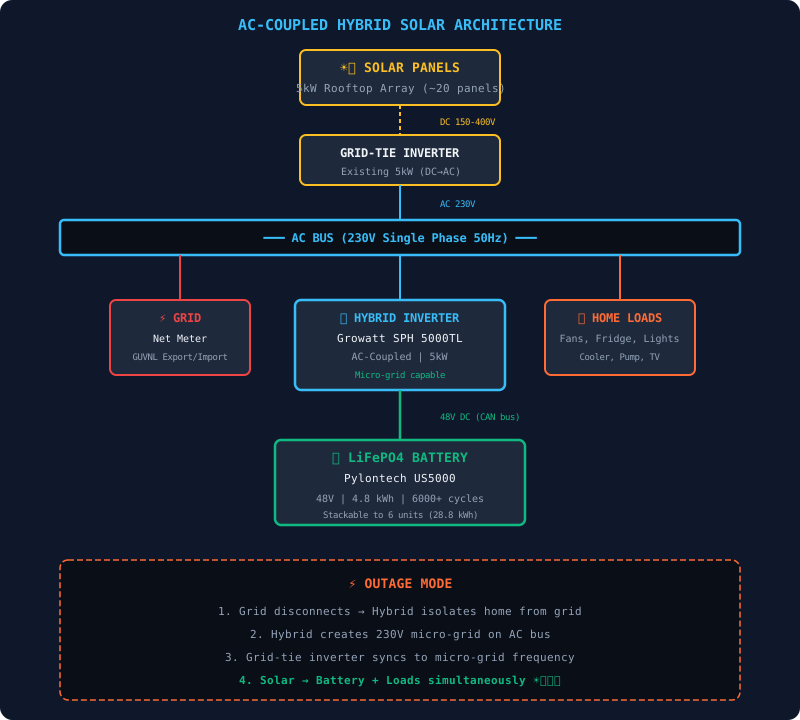
The solution: an AC-coupled hybrid inverter with LiFePO4 battery storage that creates a micro-grid during outages, allowing your existing solar panels to charge batteries and power your home simultaneously.
System Architecture
Why AC-Coupled?
The key architectural decision is AC-coupled vs DC-coupled. Since the house already has a working grid-tie inverter and net metering agreement with GUVNL, we don’t want to rip that out.
| Approach | How It Works | Retrofit Complexity |
|---|---|---|
| AC-Coupled ✅ | Hybrid inverter connects on AC bus alongside existing grid-tie. No panel rewiring. | Low — add inverter + battery, connect to DB |
| DC-Coupled ❌ | Hybrid replaces grid-tie inverter. Panels rewired to new MPPT inputs. | High — full system redesign |
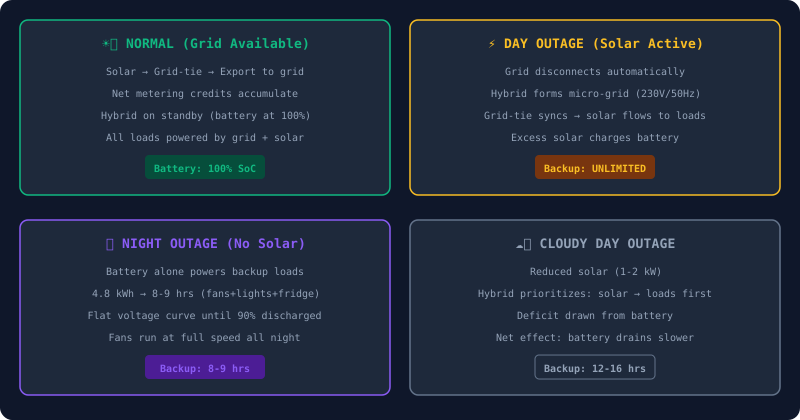
AC-coupled means the hybrid inverter sits between the AC bus and the battery. During outages, it creates a stable 230V micro-grid that the existing grid-tie inverter can sync to — so solar keeps flowing even without the grid.
Operating Modes
Component Selection
Hybrid Inverter: Growatt SPH 5000TL BL-UP
| Specification | Value |
|---|---|
| Rated Power | 5 kW continuous |
| AC Input/Output | 230V, 50Hz, Single Phase |
| Battery Voltage | 48V (40-60V range) |
| Max Charge Current | 100A |
| Transfer Time | Less than 10ms (UPS-grade) |
| Communication | CAN/RS485 (Pylontech native) |
| Monitoring | WiFi + ShinePhone App |
| AC-Coupled Mode | ✅ Micro-grid capable |
| IP Rating | IP65 (outdoor rated) |
| Warranty | 5 years (extendable to 10) |
Why Growatt: Native CAN bus protocol with Pylontech (plug-and-play, no custom wiring), proven AC-coupled micro-grid formation, strong dealer network in Gujarat, and the ShinePhone app provides real-time monitoring of solar production, battery SoC, and load consumption.
Battery: Pylontech US5000
| Specification | Value |
|---|---|
| Chemistry | LiFePO4 (Lithium Iron Phosphate) |
| Nominal Voltage | 48V |
| Total Capacity | 4.8 kWh (100Ah) |
| Usable Capacity | 4.56 kWh (95% DoD) |
| Cycle Life | 6,000+ cycles @ 90% DoD |
| Calendar Life | 15+ years |
| Max Charge/Discharge | 100A / 100A |
| Weight | 36 kg |
| Dimensions | 442 × 410 × 132 mm |
| Stackable | Up to 6 units (28.8 kWh) |
| BMS | Built-in, CAN bus protocol |
| Warranty | 10 years |
LiFePO4 vs Lead-Acid: Why Lithium Wins
| Factor | Lead-Acid Tubular | LiFePO4 |
|---|---|---|
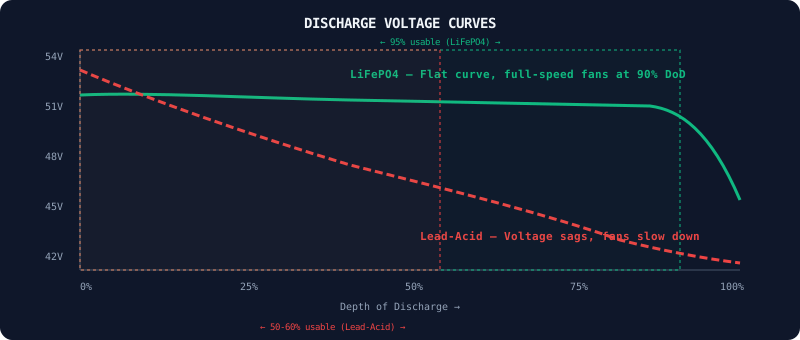
| Usable capacity | 50-60% DoD | 95% DoD |
| Cycle life | 1,200-1,500 | 6,000+ |
| Calendar life | 3-5 years | 15+ years |
| Voltage under load | Sags progressively | Flat until 90% discharged |
| Charge efficiency | 80-85% | 95-98% |
| Full charge time | 15+ hours | 2-3 hours (critical for solar) |
| Weight (equivalent) | 220 kg | 36 kg |
| Maintenance | Water topping every 2-3 months | Zero |
| Gujarat heat tolerance | Degrades fast at 45°C | Better with BMS thermal management |
The charge efficiency point is critical for solar: lead-acid wastes 15-20% of solar energy as heat during charging. LiFePO4 captures 95-98% — meaning more of your 5kW solar production actually ends up stored.
Backup Load Analysis
| Appliance | Watts | Qty | Total |
|---|---|---|---|
| Ceiling Fans | 75W | 4 | 300W |
| LED Lights | 10W | 8 | 80W |
| WiFi Router | 15W | 1 | 15W |
| Refrigerator | 150W | 1 | 150W |
| TV (LED 43”) | 80W | 1 | 80W |
| Phone Charging | 20W | 3 | 60W |
| Desert Cooler | 180W | 1 | 180W |
| Water Pump (0.5HP) | 370W | 1 | 370W |
Backup Duration (4.8 kWh Battery)
| Scenario | Load | Duration |
|---|---|---|
| Night (fans + lights + fridge) | ~545W | 8-9 hours |
| Day (+ cooler + TV) | ~865W | 5-6 hours |
| Heavy (+ pump intermittent) | ~1,235W | 3-4 hours |
| Day + Solar (outage with sun) | Net 0W | Unlimited ☀️ |
Cost & ROI
System Cost
| Component | Model | Price (₹) |
|---|---|---|
| Hybrid Inverter | Growatt SPH 5000TL BL-UP | ₹1,00,000 - 1,30,000 |
| LiFePO4 Battery | Pylontech US5000 (4.8 kWh) | ₹1,50,000 - 1,80,000 |
| Installation | Wiring, changeover, DB mods | ₹15,000 - 25,000 |
| Total | ₹2,65,000 - 3,35,000 |
15-Year Total Cost of Ownership
| Metric | Lead-Acid (4×150Ah) | LiFePO4 (Pylontech) |
|---|---|---|
| Upfront battery cost | ₹52,000-60,000 | ₹1,50,000-1,80,000 |
| Replacements (15 yr) | 3-4 sets = ₹1,56,000-2,40,000 | 0 (lasts 15+ years) |
| Maintenance (15 yr) | ₹7,500-15,000 | ₹0 |
| Total 15-year cost | ₹2,15,000-3,15,000 | ₹1,50,000-1,80,000 |
| Effective annual cost | ₹14,300-21,000/yr | ₹10,000-12,000/yr |
LiFePO4 is cheaper over the system lifetime despite 3× higher upfront cost — and you never deal with acid fumes, water topping, or degraded performance.
Expansion Path
| Addition | Capacity | Backup Boost | Cost |
|---|---|---|---|
| +1× Pylontech US5000 | 9.6 kWh total | 14-18 hours | +₹1,50,000-1,80,000 |
| +2× Pylontech US5000 | 14.4 kWh total | 20+ hours | +₹3,00,000-3,60,000 |
With 5kW solar in Gujarat, even 9.6 kWh refills completely by noon. You’d essentially never notice an outage.
Legal Compliance (MGVCL / GERC)
This system operates under the jurisdiction of MGVCL (Madhya Gujarat Vij Company Limited), the distribution company for Anand district, regulated by GERC (Gujarat Electricity Regulatory Commission).
Regulatory Framework
| Authority | Role | Key Document |
|---|---|---|
| GERC | State electricity regulator | Net Metering Rooftop Solar PV Regulations, 2016 (Fifth Amendment, Dec 2025) |
| GUVNL | Parent holding company | Policy umbrella for all Gujarat discoms |
| MGVCL | Distribution company (Anand) | Implements GERC regulations locally |
| MNRE | Central govt ministry | PM Surya Ghar: Muft Bijli Yojana guidelines (Sep 2024) |
| CEA | Central Electricity Authority | Technical Standards for Grid Connectivity (2019, amended 2023) |
What’s Explicitly Allowed
| Action | Legal Basis |
|---|---|
| Adding battery to existing net-metered system | MNRE PM Surya Ghar operational guidelines (Sep 2024) — explicitly includes BESS as permitted component |
| Self-consumption from battery during outages | GERC regulates grid interaction only; behind-the-meter consumption is consumer’s prerogative |
| Hybrid inverter with anti-islanding | CEA Technical Standards for Grid Connectivity mandate anti-islanding; hybrid inverters comply by design |
| Solar charging battery during grid outage | No grid export during outage = no regulatory concern |
| AC-coupled addition (existing grid-tie unchanged) | Grid-tie inverter and net meter agreement remain unmodified |
What’s Prohibited
| Action | Regulation |
|---|---|
| Exporting grid-charged battery energy to grid | GERC Net Metering Regulations — only solar-generated energy may be exported |
| Operating without anti-islanding | CEA Technical Standards §6.3 — mandatory grid disconnect within 2 seconds |
| Exceeding sanctioned connected load | GERC §4(1) — system capacity ≤ sanctioned load |
CEA Technical Requirements vs Growatt SPH 5000
| CEA Requirement | Specification | Growatt SPH 5000 | Status |
|---|---|---|---|
| Anti-islanding disconnect | Within 2 seconds of grid loss | Built-in, automatic | ✅ Compliant |
| Reconnection delay | Minimum 180 seconds after grid restore | 300s default (configurable) | ✅ Compliant |
| Frequency operating range | 47.5 – 51.5 Hz | 47.5 – 51.5 Hz | ✅ Compliant |
| Voltage operating range | 180 – 270V (single phase) | 180 – 270V | ✅ Compliant |
| Power quality (THD) | Total Harmonic Distortion below 5% | THD below 3% | ✅ Exceeds |
| DC injection limit | Below 0.5% of rated current | Below 0.5% | ✅ Compliant |
| Power factor | 0.85 lagging to 0.85 leading | 0.8 lag to 0.8 lead | ✅ Compliant |
MGVCL Net Metering Parameters (Your System)
| Parameter | MGVCL/GERC Rule | Your System |
|---|---|---|
| Size limit | Up to sanctioned connected load | 5kW (within limit) |
| Export rate | APPC ~₹3.40-3.80/unit | Unchanged by battery addition |
| Settlement | Annual banking (surplus carries forward) | Unchanged |
| Feasibility study | Not required for ≤10 kW | Not required |
| System strengthening | MGVCL bears cost for ≤6 kW | MGVCL bears cost |
| Bidirectional meter | DISCOM-supplied, consumer-paid | Already installed |
Notification Requirement
Recommended: Submit a written intimation to MGVCL Anand Division office notifying the addition of battery storage equipment. This is not a full re-application — your net metering agreement and grid-tie inverter remain unchanged.
For an AC-coupled system (adding hybrid inverter alongside existing grid-tie), the commissioning certificate doesn’t change since the grid-facing inverter is the same. Many installers proceed without formal notification since it’s a behind-the-meter addition, but written intimation provides full regulatory cover.
References
- GERC (Net Metering Rooftop Solar PV Grid Interactive Systems) Regulations, 2016 — gerc.gujarat.gov.in
- GERC Fifth Amendment (December 2025) — removes separate connectivity agreement for PM Surya Ghar installations
- MNRE PM Surya Ghar: Muft Bijli Yojana Operational Guidelines (September 2024) — explicitly permits BESS
- CEA Technical Standards for Connectivity of Distributed Generation Resources (2019, amended 2023) — anti-islanding, power quality
- IS 16169:2014 — Grid-connected solar PV inverter safety requirements
- MGVCL Solar Rooftop Portal — suryagujarat.guvnl.in
Installation Notes
| Item | Specification |
|---|---|
| Mounting | Wall-mount (inverter) + floor rack (battery) |
| Wiring | 6mm² copper, separate backup DB for critical loads |
| Changeover | Automatic (under 10ms, built into hybrid) |
| Earthing | Separate earth rod (IS 3043 requirement) |
| Surge Protection | Type 2 SPD on AC side (Gujarat lightning season Jun-Sep) |
| Communication | CAN cable included with Pylontech (2m) |
| Monitoring | Growatt ShineWiFi-X dongle (included) |
Critical: Get a Growatt-authorized installer, not a local electrician. AC-coupled micro-grid setup requires understanding of the changeover logic and CAN bus configuration. Gujarat has multiple authorized dealers in Ahmedabad and Vadodara — they service Anand.
Summary
This system turns idle solar panels into an active backup power source during outages — legally, efficiently, and with zero maintenance for 15+ years. The LiFePO4 chemistry ensures consistent voltage (no fan slowdown), fast solar recharging (full in 2-3 hours), and a total cost of ownership that beats lead-acid over the system lifetime.
For a Gujarat home with 5kW solar and 3-6 hour summer outages, this is the correct architecture: keep your net metering export, add battery backup that solar charges during the day, and sleep through night outages on a single charge.